Tuesday, November 25, 2008

National Day of Listening, Pedagogy of Powerpoint,and Holiday Wishes.

NPR is promoting the National day of Listening the day after Thanksgiving -
NEW YORK – StoryCorps, the most ambitious oral history project ever undertaken, will launch the first annual National Day of Listening on November 28, 2008. On Thanksgiving, Americans and loved ones gather to share a meal, express their gratitude and reminisce. StoryCorps is asking Americans to linger a little longer in the Thanksgiving spirit and honor a loved one by conducting an interview about his or her life.
This site provides more detail and audio as well as links to a guide to helping you through the interview as well as how to archive and/or share it. In addition to being a great idea for family and personal reasons, it could be a foray into podcasting. If your audio is 8 minutes or less and relates to content taught here at the school, or pedagogy/andragogy, we'd post it on our podcast. You will greatly appreciate the time you spend doing this - regardless of when or if you post it.

Also this week, we have a new resource on the pedagogy of powerpoint - focusing on when, where and why. There's a pretty funny and apt teachertube video on the subject - regrettably the resolution could be better.

Need something more to be thankful for? Free downloads of Bob Dylan and Johnny Cash performing together in 1969. Via openculture

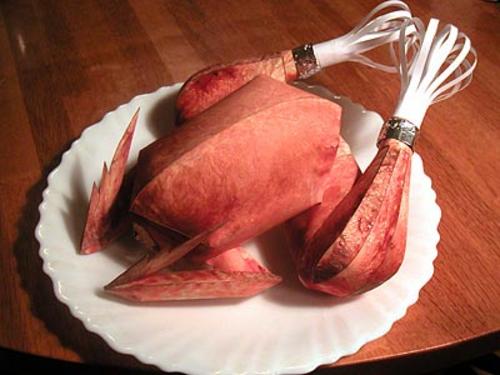
BTW: the turkey is oragami/ papercraft. Taken originally from a Japanese website - find English directions and info here.

Friday, November 21, 2008

Grants and resources for instruction in the arts

Recently in discussion of grants and funding available on campus, someone said, "Why isn't there any money for the arts?" Well, there is, for example the National Endowment for the Humanities, and The Wallace Foundation. Edutopia (a George Lucas educational foundation) has a post on the best places for grant information.

Susan Turner, who writes grants for the college, advises to start early and not underestimate the time needed. She notes that potential grant requests relate to a project—usually within a program area—that can be described and budgeted. All potential requests for funding will be prioritized by the Provost.

Grant requests are based on a problem or need that can be clearly stated. So the first step in submitting a request for funding is to complete the summary section of the approval form The next step will be to discuss the concept with the appropriate dean(s) and secure initial approval. Then submit it to Dr. Sangki Min and he will review all requests with the Provost. Susan will contact the successful requesters to discuss the request and design a realistic work-flow schedule for getting a proposal out the door! Her first concern is developing that work-flow schedule (back dated from the submission date) so that there will be adequate time spent on the research and writing and reviewing stages.

All grant requests should include a timeline of who is responsible for what stage as the project is implemented.

Tuesday, November 18, 2008

TechTALK wrap up

This post will be a place to respond to ideas from those who attended our session.

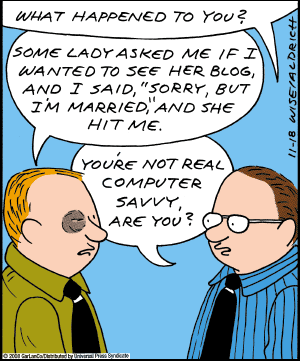
Thanks to Herschel Martin who suggested the following cartoon from Real Life adventures.

Let us know what you'd like to know about, or what applications might work best for your class. Post to the comments here and let's extend the conversation.

Monday, November 17, 2008

Web 2.0 - controlling the message

Susan from Online Ed. facilitated with me, Greg, from T3 on a category of Web 2.0 applications.

For a condensed audio podcast on Web 2.0 - check out what I presented at the international NCSPOD conference. An earlier post described the format and process of the GIFT presentation. I intended to present identical 8 minute teacher-fronted informative mini-lectures, but interesting things happened (Click on links to hear it). In the first session a mad torrent of information comes out. Pace and frequent mammoth embedded relative clauses obscure organization. In the second session the audience takes part guiding discussion, wikis get attention and themes such as the Guttenberg project and ESL or international students get treatment. In the final session, a great idea from another presenter (on recognizing faculty and sharing info) is mentioned and the focus is more on the philosophy of Web 2.0. Reviewing the audio has lead to some productive self-assessment.


Isn't the headgear a nice touch?

What do you want to know more about? Post suggestions to the comments.

Friday, November 14, 2008

Why should a teacher blog

This week a series on web 2.0 applications that will lead us to the TechTALK workshop facilitated by Susan Stuart and myself (Wed. noon in 3207 - RSVP to B.Hayes).

An excellent job making the case for blogging in education (How/Why/etc. mainly through loads of links) has been done by another blogger - and I've done it through anecdote at my first educational blog, but here I'll throw some recent hard research at you.

A blogging case study (Armstrong and Retterer, 2008) from the AACE Journal, affirmed that computer mediated communication makes writing more fun for students and there's indication that students wrote more, felt more confident and more accurately assimilated second language linguistic features (without overt instruction in grammar).

A phenomenological qualitative study (Felix, 2007) found first through a meta-anaylsis that
differentiated instruction, using multiple modes of presentation, will positively increase a student’s opportunity for learning. Communicating efficiently, using various communication methods, will enhance a teacher’s instructional effectiveness and a student’s ability to understand. Blogging appears to offer multiple opportunities [for this]...
No big surprise. But then the study itself
  1. highlights the importance of writing in education,
  2. finds that blogging teachers changed instruction to more actively engage students
  3. indicates that blogging leads to greater collaboration, connected learning, cognitive complexity, student/ teacher dialogue
In E-mail in Academia, a refereed journal article from EDUCAUSE, faculty noted that they liked using email for communication, but didn't like answering substantive questions thru email. Students still feel more comfortable (due to shyness, or because written questions can be better composed) asking these questions thru email. If it's a personal issue or grades - office hours are the way to go, but if it's something the whole class could benefit from - blog it! That way you can share the info with everyone, and archive it indefinitely to pre-emptively address future classes - without necessarily identifying the source of the question.

For an example (case study(?)) using blogging in a class click here.

Thursday, November 13, 2008

Writing comics and irritating usage


How many decent regularly produced comics do you know about writing and/or grammar? Here's one to check out from Karen Riddick, who does an electronic magazine (an e-zine) on writing and usage (and who just published a book). Click on the image to see a complete, full-size comic (shrinking it to fit the blog compromised legibility). This is a great source for images to embed in lessons (a la wikis, email, blogs etc.) to punch up interest and spark discussion.

The example above links mechanics and linguistic meta-language with the current election. Connecting learning to our students' lives makes it click. Also on the issue of the topic of the above comic, Oxford researchers have released a list of the top 10 most irritating words or phrases in English. Not all of them are cliches, but...

And what is the difference between a cliche and a colloquialism?

Title 3's Denver Conference: casa bonita

Of course it was business during conference hours, and handouts and powerpoints from the conference are available now online.

But the real story may have been the dining tip Media Guru J. H. gave the T3 team. "An experience you won't forget - Cliff Divers in a Mexican restaurant - Casa Bonita" Turns out South Park has done a sanitized and idolized treatment of the place. That episode (see complete show here ) is one of the creators' top 10 favorite episodes.

Think an aging theme park crossed with the dinosaur restaurant. Think theater production values approaching a small town renaissance festival in a down year: high school students shouting into a squawking P.A. system that rendered them absolutely incomprehensible. Kitsch on an absurd scale.

I had a great time and we all have a story. Did you know of said Media Guru's reputation as a practical joker? In his defense he claims to have not been there for 20 years, but you have to suspect him. Someone should've tried the margaritas.

The food aspired to concession stand standards, but the wait staff were warm, friendly and harried. The mariachi's (seen here singing me happy birthday) rocked.