Showing posts with label video. Show all posts

Monday, March 23, 2009

Tech TALK 3.25.09

The last half of this TechTALK will feature activities you can take directly back to the classroom. It will be hand's on and interactive and will use Team-Based Learning strategies to meet it's objectives. I plan on "teaching with my mouth shut" as much as possible - taking a nod from a book I've been hearing about lately.

The objectives: to support the pedagogy (andragogy) required to justify use of web-based network technologies in the classroom. As an object lesson, we will collaborate and create relevant content, and share it with each other using readily available tools/ applications available free online or through ANGEL.
Our Datatel representative recently said that 2/3 rds of the sucess of any technology initiative are cultural, and only 1/3 is the mechanics of using the technology. Scholars from the humanities who tend to write on the subject (Cummins and others) also say that sucess with any computer-mediated communication (CMC) or computer-aided learning comes from pedagogy rather than technology. So we're going to do activities that lend themselves to digital platforms and demonstrate or assess our outcomes -


I've done the activities and they're fun.

The images here come from a book, Using Wikis for Online Collaboration by J. West and M. West (2009). Also from the book we learn important steps in the conceptualization and planning of a wiki, uses of wikis (FAQ page, team collaboration spaces, critical thinking and collaborative writing assignments, and more). The book also contains
  1. sample rubrics for every step of the process,
  2. advice for managing the process,
  3. activities for knowledge construction (FAQ, an annotated bibliography, etc.)
  4. as well as basic how-to information.
Resources on wiki basics: What is it? Why? How? etc.

Faculty support wiki page to support this presentation available click here.

There willbe door prizes!

Thursday, March 5, 2009

Lectures: gone in 60 seconds

The Chronicle of Higher Ed. 3-6-9 has a fascinating FREE article on effective online lectures. Called "microlectures" the context discussed is community colleges. While some doubt that their topics can be boiled down, the article interviews a variety of deans and course designers who have been won over. IMHO, this may be because the format requires the teacher to break complex ideas down into more easily digestible chunks. Students love it.

NOTE: these microlectures should be combined with readings and activities that require them to explore the ideas.

The format encourages active learning. Read more.

The following extended quote is take from the article.

HOW TO CREATE A ONE-MINUTE LECTURE

David Penrose, a course designer for SunGard Higher Education who developed San Juan College's microlectures, suggests that it can be done in five steps:

1. List the key concepts you are trying to convey in the 60-minute lecture. That series of phrases will form the core of your microlecture.

2. Write a 15 to 30-second introduction and conclusion. They will provide context for your key concepts.

3. Record these three elements using a microphone and Web camera. (The college information-technology department can provide advice and facilities.) If you want to produce an audio-only lecture, no Webcam is necessary. The finished product should be 60 seconds to three minutes long.

4. Design an assignment to follow the lecture that will direct students to readings or activities that allow them to explore the key concepts. Combined with a written assignment, that should allow students to learn the material.

5. Upload the video and assignment to your course-management software.

Monday, November 17, 2008

Web 2.0 - controlling the message

Susan from Online Ed. facilitated with me, Greg, from T3 on a category of Web 2.0 applications.

For a condensed audio podcast on Web 2.0 - check out what I presented at the international NCSPOD conference. An earlier post described the format and process of the GIFT presentation. I intended to present identical 8 minute teacher-fronted informative mini-lectures, but interesting things happened (Click on links to hear it). In the first session a mad torrent of information comes out. Pace and frequent mammoth embedded relative clauses obscure organization. In the second session the audience takes part guiding discussion, wikis get attention and themes such as the Guttenberg project and ESL or international students get treatment. In the final session, a great idea from another presenter (on recognizing faculty and sharing info) is mentioned and the focus is more on the philosophy of Web 2.0. Reviewing the audio has lead to some productive self-assessment.


Isn't the headgear a nice touch?

What do you want to know more about? Post suggestions to the comments.

Monday, October 13, 2008

Web resources for teachers

Going to try a new format. Too much fun (and potentially relevant) stuff; if it isn't shared quick it could be lost, so minimal descriptions

Video of scholarly and education merit to provoke discussion (or digression):
  1. Anthropology: KSU's web celeb anthropologist Michael Wesch
  2. Biology - crab rides a jellyfish; Learning about memory and aging on YouTube
  3. Business: Yale professor explains financial crisis in 10 minutes
  4. Chemistry;
  5. Physics (including a boomarang in zero gravity);
  6. Art: THe 50 greatest art videos on YouTube;
  7. Collections: NYTimes top 5 online video lectures - and Open Cultures top 75 online educational videos - part of their "signs of intelligent life on youtube collection". Free Engineering and SCience courses from Stanford online; source to watch complete documentary films for free;
  8. Pedagogy: Father Guido Sarducci breaks it down (learning and retention- Remember Saturday Night Live in the late 70's? funny because it's true)

See Also

Thursday, August 28, 2008

Cool academic resources: Media rich

More educators are incorporating wikis and blogs into their classes. Web spaces are great places to share syllabi, lesson plans, and handouts. Research shows students expect it. Furthermore, they have a great potential “fun factor.” These formats allow for embedding video, pictures, links, audio and more. Web-enhancements, whether through LMS (like Angel) or through free Web 2.0 tools, efficiently share supplemental, and/or media rich material.

Here’s a list of both highly academic and fun resources. Check them out and share with students.


Tuesday, August 19, 2008

Teaching with embedded video

Our campus community has an impressive online video presence.

In fact, in the most recent online video to go "viral," you can see a Fort Hays debate coach lose it and moon for rebuttal. One of our own acts as the voice of reason and calm. You may have seen it on network news. YouTube pulled the video, but it's up on Live Leak, viewable at Boing Boing (It is intense - contains very coarse language and, as I said, an exposed rear-end).

The Strawberry Fields Community Garden Project, produced by the school's economics club in conjunction with the Strawberry Hill Home association, shows community involvement and applied, active learning. It features Dr. Medhi Shariati, as well as several students you see in the halls or in class. It's the featured video this week to your right.

The music department represents us with class through many videos of the Blues Devils. Different musicians and musical genres show up. Sometimes the camera is on a tripod, and sometimes on the shoulder of someone in the back of the audience, but the obvious sense of fun makes them worth checking out.

The track team also shares video to assess and improve performance.

See the growing list of examples of our excellence at the forefront of online shared video.

Wednesday, July 23, 2008

The importance of humor in teaching

Several unrelated events conspired to inspire the topic today: humor and teaching. A math instructor remarked on the role jokes play in keeping students engaged, and an article on challenges facing adjuncts inadvertently got me thinking about the importance of a sense of humor for teachers.

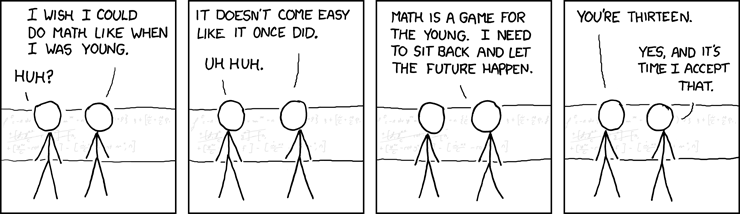
There are many sources for cartoons for educational purposes online. Cartoons on the web can often be embedded without violating copyright – since 1) it doesn’t technically exist on our site 2) we don't sell it and 3) it's for educational purposes. Images may look better on wiki pages, but... for example from http://xkcd.com/:

Taylor Mali, a teacher turned Slam Poet, has great teaching material on YouTube. Experiencing his poetry (more stand up/ spoken word with a hip hop feel) is hilarious, and he treats math, history and of course language arts. See a collection of links . He’s featured in the video to your right. I particularly like his piece on “The Impotence of Proofreading,” but his rant on “what a teacher really makes” lifts your spirits and provides perspective.

The Faculty Staff Development Library has humorous resources for teaching: books by Al Franken and Bill Cosby, books on topics such as games for instruction, and videos like “what’s so funny about work,” and more.

Victor Borge’s a phonetic punctuation system can lighten up a grammar discussion and teach mechanics. And for me it's practical; living in multilingual environments, I sometimes speak out punctuation to clarify meaning.

additional links:


Monday, July 7, 2008

Web resources with a Math/ Science / Technology (MST) focus.


The web has a wealth of material to support teaching of the sciences. Youtube offers many, but the problem with youtube is that it isn’t easy to find relevant, quality, content. Luckily Open Culture has done that recently. You can also find resources through our social bookmarking site and at http://del.icio.us/gdixon/math.

Primarily MST resources


Wide variety of subject interests - Sciences and Humanities

Many universities and an increasing number of community colleges are making course content available free online. Generally, these schools consider sharing content to be a community service.

  • The University of Pennsylvania has a 60 second lecture series on a wide variety of topics including chemistry, physics, history, psychology, women’s studies and more. They have some big names. . I stumbled upon it through the presentation by Labov – a giant in linguistics. Because the format is around a minute long – it requires subject experts to summarize, which is an invaluable tool for effective teaching.
  • Uchannel, associated with Princeton, aggregates (collects) feeds from many quality institutions.
  • UC Berkeley has pioneered the use of YouTube to deliver content.
If you have resources you've found that you like, please share them by commenting to this post.


Tuesday, June 24, 2008

Resources for teaching 6-24-8

This week we mourn the passing of George Carlin, Counter-Culture’s comedian of the 70’s and 80’s and a prolific writer more recently. He created one of the best ways to teach both comparison contrast and the use of metaphor in language through multimedia available free online in a routine called, “Football vs. Baseball.” Find the text and audio , and you can also see video via several sites on YouTube . See him perform the monologue and /or an interesting slide montage. I'll try embedding a video somewhere. The slide montage might really work with Non-native English speakers.

Also a shout out to Janice McIntyre and those who have been using www.freerice.com to build and reinforce vocabulary. She says her students wouldn’t leave class one day because they were so engaged. Designed by a computer programmer who wanted to boost his children’s SAT scores, not only will the game make you smarter, every correct answer feeds the hungry worldwide through the U.N. World Food Programme. There’s a great audio program (with text) from NPR.

NPR provides some great resources. Today they mentioned the Wallace Foundation as a resource for teachers. The site bills itself as high quality source for learning and enrichment activities. They also sponsor grants.

The Chronicle of Higher Education this week praised one of my favorite sites, Open Culture, for teaching resources and for personal enlightenment/ entertainment/ etc. The Chronicle discusses the great online courses available free, but I download audio books and audio short stories. Open Culture also sifts through the morass of YouTube and finds teaching and educational stuff actually worth viewing (it’s out there – really!) And, Open Culture updates frequently. Another collection of redeemable YouTube videos can be found at their smart youtube viewing collection.