Showing posts with label statistics. Show all posts

Monday, September 22, 2008

The Effect of Web-enhancement on Classes – Quantitative Research.

An article by Wingard (2004) ,
Classroom Teaching Changes in Web-Ehanced Courses,
"assessed the kinds of changes that occur in face-to-face instruction when faculty add Web enhancements to their course. "

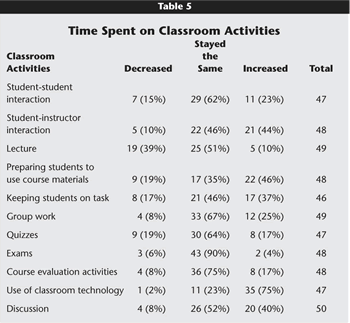
It comes up with some expected and unexpected results. The affected faculty expected the following:
  • more efficient face-to-face interactions, better class discussions
  • more active learning,
  • less lecture
  • more readily available practice and feedback opportunities for students, and
  • more student-centered instruction.
That was essentially the case; moreover, “an unanticipated consequence of continual and comprehensive student access to course materials and resources was an elevation of faculty's expectations for students" [emphasis mine].

Where change was noted it was much more likely to be positive.

Source: Educause. Follow link in first sentence for full article.


Wednesday, September 10, 2008

Teachers Should have an Angel (online shell)

Angel is a place to put your stuff - online: a learning management system (LMS) also called a Course Management System (CMS). Here we use Angel mostly for fully online or distance learning, but other campuses provide an LMS for any class offered. You want to have Angel for an on-ground class, such as:
  • Copyright protection. Having content behind a password protected shell/firewall/ whatever, may keep the college from getting sued. Copyright law is ambiguous - sometimes intentionally so, and anyone can benefit from an added layer of protection. See Dr. Rosemary Talub’s Presentation from SIDLIT.
  • Students who transfer will have to use an LMS - Blackboard at KU, KSU Online at KSU or Moodle at Baker. They function similarly.
  • Students want it.
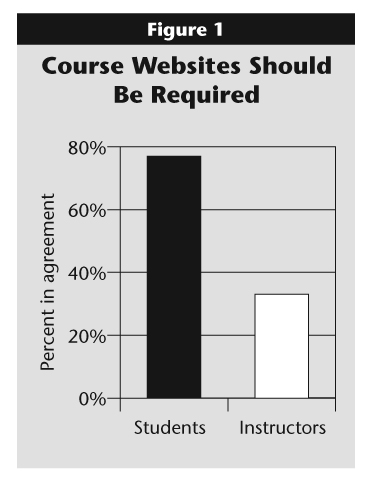
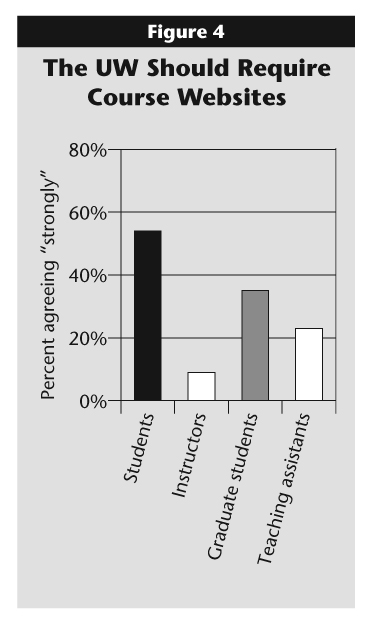
Students and faculty have widely and wildly different expectations. The embedded tables are from an Educause article which provided a meta-analysis of over 100 universities and community colleges. Our own Chan Tung published similar results.

Also, although the process may differ from department to department, it requires a) institutional approval b) at least a semester advance notice c) that you take a "course" online from OES - to learn the system and get the students' perspective.

Because instructors may not know what section of a course they will be teaching or if it will fill, it’s challenging to arrange to have web-enhancement, particularly for an adjunct.

What are other obstacles, resistance, do faculty have to web-enhancement?

Wednesday, July 30, 2008

adjuncts: support and development

One recurring theme of this blog is the support of adjunct instructors. Several times I've supported myself and others exclusively through adjunct work at multiple locations, logging as many as 700 miles a week. That's what got me hooked on audio books. Here , in the fall of 2007, as many as 43.7% of classes were taught by adjunct faculty who aren't otherwise employed on campus.

When you consider that adjuncts teach fewer classes - that's a lot of people who work out of their cars, make due with limited, communal, office spaces and spread their commitments across several schools or businesses. Several sources note that the price of gas has already steered startling numbers of students toward online classes, and experts predict these classes will be taught predominantly by adjuncts. These aren't the only challenges facing adjuncts.

Support for adjunct faculty development.
We have significant resources for adjunct faculty, that many don't know about. The Faculty- Staff Development (FSD) site is a great place to find resources. From there, and additionally:
  • adjuncts can present symposia and there is a stipend (200$?).
  • Funds (up to 375$) are available to attend conferences. (note: be willing to share what you learn. Perhaps write for this blog or interviewing for the audio podcast)
  • the FSD adjunct page has the adjunct handbook and several newsletters from different adjunct support organizations.
  • FSD sponsors Dine & Design and TechTALK presentations where we share strategies, activies (we don't like the term "lesson plans" but you get the idea), and theory.
  • you can download Softchalk Software for creating cool interactive online quizzes and instructional material (it's in Angel Support materials). We will have to discuss the benefits of Angel in a future post.

What do you need to know and / or want to talk about? How can we better support adjunct faculty? Post to the comments section of this article.